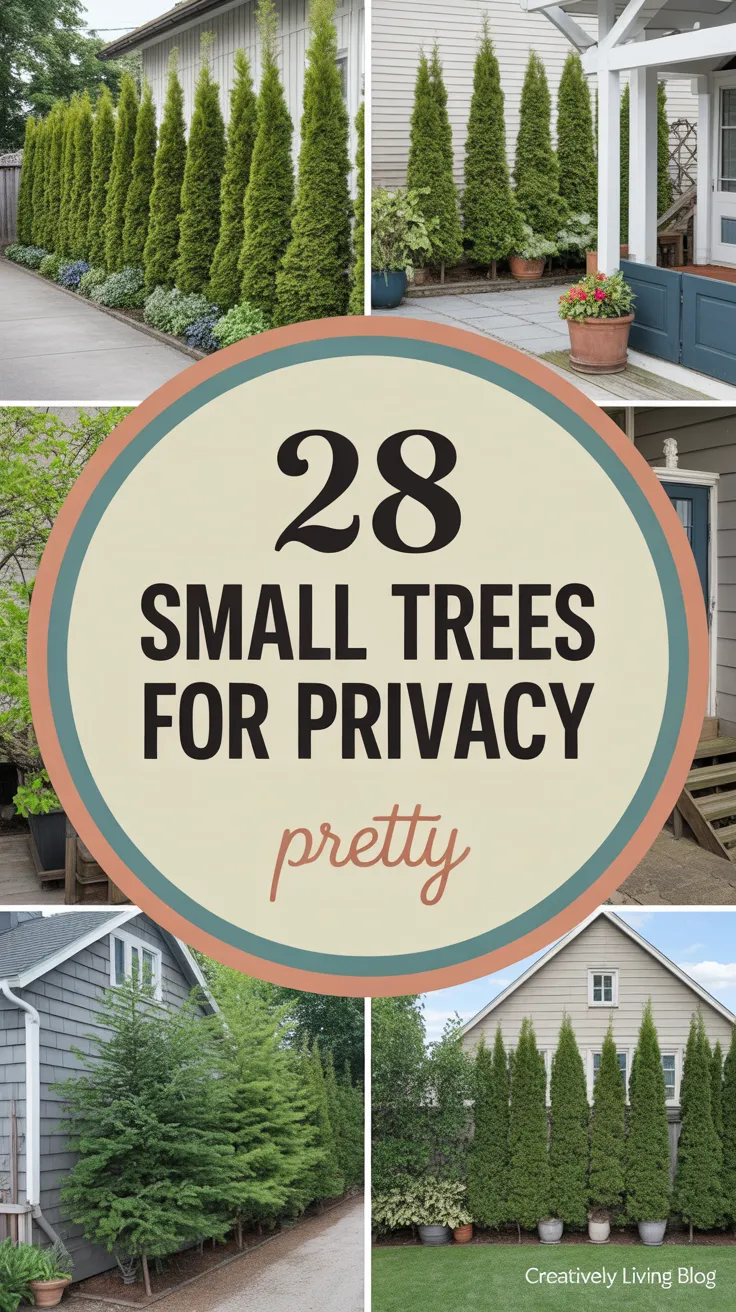
Our garden should be a private space hidden from the world. Landscaping for privacy can make us good neighbours and shield us from the wind. In this article, we will look at 28 different examples of small trees that we can use to ensure privacy in our garden. But now, let’s learn a little about the garden arrangement first.
It is very important to study the character and communicative qualities of a plant. For example, the common favourite, white-skinned birch, undemanding to the soil is not afraid of frost. At the same time, a willing “individual peasant” can drink up to 250 litres of water per day. But shade tolerant fragrant linden can increase the fertility of the soil, rotting leaves enrich the upper layers of the earth with microelements, it gets along well with oak, maple and mountain ash.
Which Trees Are Suitable Near the House?
Plants planted for privacy can consist of trees, shrubs and climbing vines. While choosing between these, we need to ask some questions. What kind of drainage is there? How much sun does it get? Are there power lines, cars, or walkways that need to be kept clean? Will we be able to provide the water our choices need? All these considerations should be applicable to any plant we consider for our privacy.
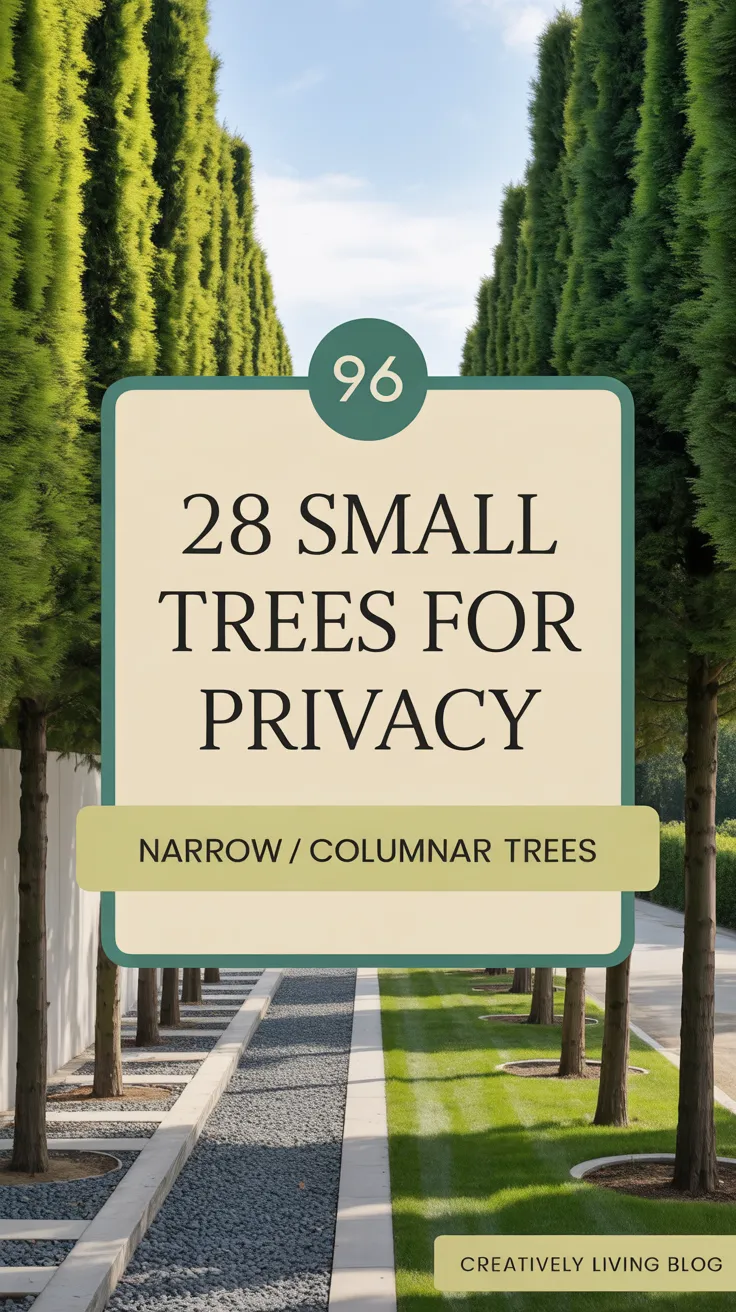
Cedars, laurels, spindles, and even bamboos, these persistent species will protect us from prying eyes year-round.
If we also consider what kind of trees should not be planted, overgrowing trees will be disturbing by blocking the windows. We can give examples as Eucalyptus, Oak, Elm, Pruning and Acacia.
Some Other Solutions for Garden Privacy
If we care about privacy in our garden, there are different options we can do other than afforestation. These,
Privacy Fence: Fences are a popular and versatile privacy option. They come in a range of materials, colors and styles that offer varying degrees of privacy.
Walls: Solid walls provide the most privacy and look attractive.
Evergreen hedges: Often made from densely planted evergreens, living hedges offer privacy and tranquillity. Well-maintained custom hedges require frequent trimming, but for a more natural, low-maintenance option we can use shrubs.
Bamboo: A bamboo stand can be an elegant and effective screening. This plant is an aggressive spreader, so regular pruning is necessary to keep it under control.
Privacy Curtains: A little fabric can go a long way. These curtains create easy privacy and provide protection against the wind.
Stone: Stone is an attractive option that gives a natural look to our garden. We can surround the stone walls with lush plants and achieve a simple but beautiful harmony.
Brick: A brick wall is a classic choice when it comes to creating a privacy fence. Flowers, shrubs, and a water feature soften the brick in the courtyard, creating a cozy outdoor retreat.
Planning Your Garden for Privacy
One of the most effective privacy options is to place clusters. Rather than sewing in a straight line, it will be more effective to sew in clusters. A panicle planting creates a natural-looking curtain for an undesirable view or a wind source without building a botanical wall. Cluster plantings can also create an interesting background for more colorful plantings in the foreground. This way we can get good airflow, nice design and more freedom in our garden.
Another way is to plant mixed borders. A mixed border planting can include both trees and shrubs of various types. Various plants will grow together and create a uniform border while offering us visual interest. Mixing plants also prevent major losses from a single disease or pest. Using different plants will attract beneficial animals, birds and insects, creating a biodiverse habitat.
Another option is to plant shrubs and trees in staggered rows. This landscape design for privacy gives us a beautiful wall effect. It also gives us more protection from the wind as we have multiple layers of vegetation. A design like this can reduce wind, noise and block an undesirable view.
Whatever type of privacy planting we choose, we should not crowd the plants when planting them. As they grow, our plants will become overcrowded, which can cause loss of lower branches, too much shade in growing specimens, insect infestations and disease.
Maintaining A Tree Planting Distance Near the Home
The tree next to the house is a classic of the garden genre. But for this classic to be compatible, we need to carefully control the distance. We are not supposed to plant large trees near the wall of the house. After all, even narrow crowned types like finely cut cherry or sakura require a lot of personal space. Another important point is the characteristics of the root system. Plants with a superficial root system, such as white acacia, irge or willow, have no place near paved roads and platforms: sooner or later their roots will simply remove the tiles. For such corners, trees with a taproot system, for example, Norway maple or willow pear, are more suitable.
The Laws of Compatibility of Trees
The circle of the tree trunk is not the most suitable place for planting other plants. Especially trees with dense superficial root system such as chestnut and lindens do not like this closeness. Only shade-tolerant and drought-tolerant herbaceous perennials such as sparrow (Lithospermum), duchenea , epi-medium and comfrey (Symphytum), as well as hardy ornamental grasses and dwarf shrubs, can compete with these individual farmers for water and nutrients. For example, shade sedge (Sageh umbrosa), Fortune’s euonymus (Euonymus fortunei) and pachysandra. Finding companions for catalpa, liquidambar, ginkgo, ornamental apple, and sakura is a little easier. Under them we can break a flower garden with Chinese dwarf astilba (Astilbe chinensis pumila), Brunnera Waldsteinia, geraniums and tiarella.
Which Tree Orders Faster?
The fastest growing trees are:
- Basswood
- 2.Silver Maple
- Poplar
- Eucalyptus
- Larch
- Oleander
- Catalpa
- Birch
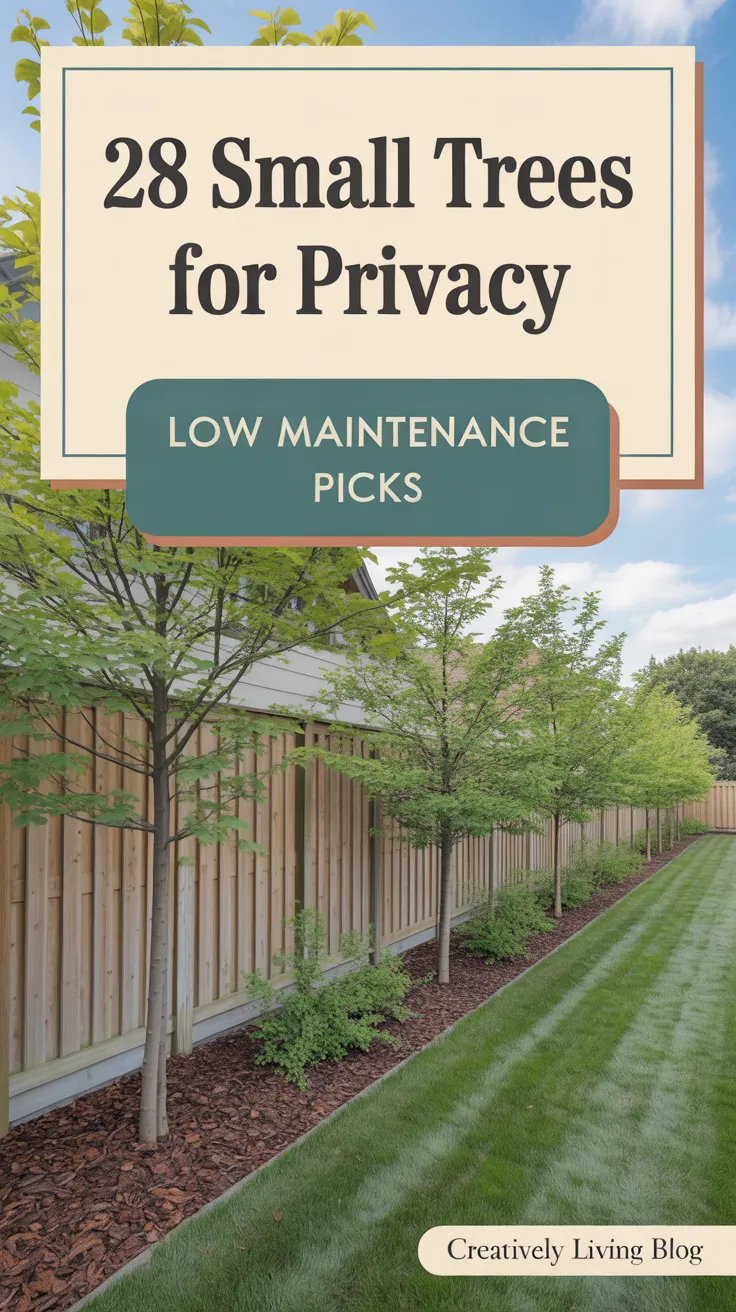
We currently have a general knowledge of garden privacy and trees. Now let’s examine 28 small trees that are suitable for the privacy of our garden.
1.Dogwood Tree
Large pink, red, or white spring flowers, showy red berries, and impressive fall color are all reasons why cranberries have always been popular. Many different varieties are available, including new hybrids that are more resistant to diseases.
Cultivated as large shrubs or small trees, dogwoods add value to the garden throughout the year. To a pleasant surprise, they produce edible strawberry-like fruits in summer, which attract songbirds to your garden. In autumn, the tree is rich in fall color, then in winter the mottled, peeling bark turns into a striking shade shows feature.
Not all varieties are suitable for a limited space, so we should check carefully before buying. For small gardens, a dwarf dogwood like Cornus kousa ‘Angyo Dwarf’ will only reach 1.2-1.5m tall, although other varieties can grow as tall as 8m. These trees need full sun or partial shade and prefer moist, free-draining neutral to acidic soils.
2.Chastetree
This lesser-known tree is more like a large shrub, but can be pruned into a multi-trunk tree. Beautiful spikes of purple flowers appear in summer. In the north, it typically dies in winter and regrows as a bush in spring. But it makes a nice little tree in the south.
3.Seven-Son Flower
Once known only to plant collectors, this multi-trunk tree is becoming increasingly popular for its year-round beauty. It has curled leaves, peeling bark, and fragrant white flowers that become twisted red bracts. A good specimen for any landscape is a tree.
4.Carolina Silverbell
It is easily grown in average, medium, well-drained soil in full sun to part shade. It prefers moist, acidic, organically rich soils in part shade. It has an irregular, spreading, open crown and yellow fall color. It suffers during drought so will need supplemental irrigation. It makes an attractive specimen plant for a lawn or in a shrub border or woodland garden and is occasionally planted as an ornamental. It also looks attractive planted with rhododendrons and azaleas. Carolina silverbell is sensitive to heat, drought and soil compaction.
5.Redbud Tree
In early spring, teeny pink or purple flowers cling to the bare branches of this native sorceress. The beautiful heart-shaped leaves are reddish or golden, depending on the variety.Plant in full sun to partial shade in moist, well-drained soil. Eastern redbud is native and tolerates a variety of soil condition.
6.Japanese Maple
These stunning trees have delicate leaves, interesting bark, and graceful, curved limbs. The foliage comes in a variety of shades, from pale green to deep burgundy. Most varieties prefer partial shade. Like most maples, many species have stunning fall color.
7.Crape Myrtle
It blooms from mid to late summer with perennial white, pink, red or lavender flowers. Planting in shade or semi-shade can reduce the amount of flowers. The leaves turn yellow, orange or red in the fall. Attractively exfoliating, patchy bark adds interest in winter.
8.Serviceberry
This small, shrubby tree has clusters of fragrant white flowers that turn into purple berries in autumn. We can make jam from them or share with wildlife! Most Amelanchier species have showy but short-lived flowers produced in terminal clusters that may be upright or drooping. Each flower has five petals surrounding many stamens. The petals are generally white, but some cultivars can have pink to yellow petals. The flowers only last for about a week or less if it is warm or windy.
9.Crepe Myrtle
This star of the southern landscape has dark bark, glossy leaves and vibrant fall colors. Its showy, frilly blooms come in all shades from pure white to hot pink. Once established, this tree tolerates heat, humidity, and drought.
10.Japanese Stewartia
A multi-stemmed, deciduous tree with a rounded columnar form, stewartia features stunning bark that exfoliates in strips of gray, orange, and reddish brown once the trunk attains a diameter of 2 to 3 inches. Serrated foliage emerges bronzy purple in spring, develops into a dark green by summer, and turns red or orange in the fall. In midsummer, “glamorous” white camellia-like flowers open in random succession and are followed by pointed brown seed pods, which are persistent but not very ornamental.
Grow in moist, acidic, well-drained soil in full morning sun or partial shade. Avoid a site with hot afternoon sun. Does not do well in areas where temperatures remain high during the night.
11.Magnolia
With its heavenly flowers, the magnolia is a symbol of spring, and compact varieties make some of the best trees for small gardens. They are also among the best trees for front gardens, as they provide a pleasant sight to visitors as well as filling the air with their sweet perfume. Magnolias thrive in a sunny, sheltered location and prefer moist soil. We should avoid planting in too much exposed areas, otherwise frost can reach the flowers and turn the beautiful leaves brown. When planting, we need to water well during the first few months and during any dry period in the summer.
12.Bay Tree
Laurel trees are versatile. They are evergreen, providing year-round interest, while their upright forms add plenty of ornamental value. Plus, its leaves are aromatic and add a wonderful depth of flavor to countless dishes.
These attractive trees grow very well in pots, making a beautiful feature on a patio or next to a door. They are easy to care for, but need to be placed in a sunny location and regularly watered and fed. They need repotting every two years.
13.Euonymus
Euonymus is a great choice for a small garden. It is showy with its dark pink fruits. It can be grown as a shrub or tree. The plant is tolerant of both acidic and alkaline soil, but likes moist but well-drained.
14.Japanese Maple
Japanese maple is a slow-growing small tree with an interesting growth habit that makes it attractive in winter. Many varieties are available. Beautiful, intricate, delicate leaves make the Japanese Maple a real focal point in a garden. Foliage ranges from green to deep red; some leaves are light green with red edges. Plant in partial shade in moist, acidic, well-drained soil. Protect Japanese maples from harsh afternoon summer sun.
15.Mimosa
It is exotic looking with fern like foliage and feathery-pink flowers that attract hummingbirds in mid to late summer. Blooms can be quite aromatic and are adaptable to harsh environments. Keep in mind that this Asian tree can be invasive in many areas.
16.Amelanchier
Also known as service grape, juneberry, or saskatoon, amelanchier is a delightful tree for small gardens that presents elegant star-shaped flowers in spring and turns bright red-orange leaves in autumn. The trees also produce edible purple-red berries that are similar to blueberries and have little for their flavour.
17.Olive Tree
Reminiscent of the Mediterranean, olive trees are slow-growing evergreens. However, since the trees are well suited to be grown in containers, it is best to move them to a sheltered location during the colder months. Although they may not be able to bear fruit in some places, they still make beautiful feature trees. When planting, we should add a shovel of garden sand to the soil to ensure good drainage. If they start to shed their leaves, a glass of water, a light prune, and some food will solve the problem.
18.Crabapple
Although often overlooked in favour of eating regular apples, crab apples have a lot to offer a small garden, elevating the space with their sparkling pink flowers in spring and vibrantly colored fruit in fall. Because their fruit is too sour to eat, crab apple trees are typically grown for their ornamental value, but apples make the tastiest jellies especially when we can combine them with other shrub treasures like rose hips. Crab apples like a sunny location with moist, well-draining soil and will grow well in containers.
A compact crab apple tree can brighten up a small garden. In the spring, it has beautiful clouds with beautiful flowers. It produces a plethora of tiny, richly colored fruits in shades of red, yellow, gold, and scarlet in fall, and it also has attractively colored leaves.
19.Cercis
Cercis is a great tree for fall color. In spring, cercis produces stunning pink flowers that bees love, and stunning purple pods in fall.
20. Silver Birch
The pale beauty of a silver birch is hard to beat, and the good news is that there are cultivars that are suitable for smaller gardens. Hardy, suitable for all soils and conditions, it has airy green leaves and tawny catkins in spring, turning a gorgeous golden yellow in fall. As the leaves fall, snowy white bark appears, a striking feature in itself. The tree is easy to care for: it is enough to prune dead or damaged branches from late summer to mid-winter. If the shell looks dirty, it can be washed with plain water and a sponge.
21.Acer
If we love a fall color, an acer is a must. Burning orange, red, or a rich pink color and when gorgeous leaves fall, many have ornamental bark that makes it a lovely feature. There are many different species to choose from. Acers are low-maintenance trees that rarely need pruning and are an asset to any garden.
22.Ornamental Cherry
A confetti of pink or white leaves in spring is the hallmark of cherry trees, and there are many beautiful smaller varieties that fit in a compact space. Ornamental cherry trees prefer full sun and moist, well-drained soil of any type. Once established, they require very little maintenance.
23.Rowan
They are ideal for attracting birds with clusters of blackberries in the fall. You should try the Sorbus vilmorinii variety, which has the foam of summer flowers, and then the pinkish fruits that turn white as autumn turns to winter!
24.Panicle Hydrangea
Hydrangeas are beautiful flowering shrubs, and panicle hydrangeas can work as small trees, growing up to 25 feet tall and wide. They produce tiny flowers that grow in large clusters, which start out white in July and then turn a dusty rose as summer progresses. This hardy shrub should be planted in sun to partial shade in rich, moist, well-drained soil.
25.Lemon Tree
This is a tree that is often found in many backyards. The lemon tree has fragrant flowers and leaves, and of course, provide fresh fruit that can be used in a vast variety of dishes and drinks.
26.Lilac
Lilac is a large shrub with showy, highly aromatic spring blooms. Flowers may be white or shades of pink, purple, lavender, and lilac. The leaves are susceptible to powdery mildew in hot, humid summers. Plant in full sun in well-drained soil. Prune to remove unwanted or dead twigs and branches.
27.Peach
Peach trees have dark-green leaves that provide a beautiful contrast to the attractive mid-spring flowers and the brilliant mid- to late summer fruit. Plant in full sun in moist, well-drained soil. Mulch to protect the shallow roots, and prune in late winter. Be aware that peach trees are susceptible to late frost damage and severe winter cold. Plant two or more trees for pollination.
28.Sourwood
The leaves turn a range of colors in fall. You should mulch to retain moisture and protect its shallow roots. Blooms from June to early July, with fragrant white flowers on drooping stalks that look very similar to lilies of the valley. Grows in an oval shape. Is used by bees to produce highly prized honey.
Now you have all the information you need small tree for garden privacy. We hope you found this article useful and interesting as you go about small trees for privacy. Please do let us know your thoughts in the comments below! It’s always a pleasure to hear from our readers on what they agree with or disagree with.